Viral content is the dumbest form of content marketing you can do.
I'm Andrei, and I run Literally.dev. We're an AEO and content marketing agency that helps tech companies with content. We're increasing AI mentions for our customers by 400% on average. We've 5x-ed conversion rates from content in less than three months. And we've been on the front page of Hacker News multiple times.
In our discovery calls, I often hear clients say they want to go viral. And I very rarely meet anyone who should be thinking about content this way.
Let me get into why that is, why your content strategy might be holding back your business, and what you can do instead to get actual customers with content.
The Marketing Funnel in Two Minutes
If you're reading this, there's a good chance you're familiar with the five stages of awareness. You've probably heard of funnels, and you've heard of flywheels. But just in case you're not, let's spend some time on the topic.
I like to picture everything as a funnel, because that's the mental model that makes the most sense to me.
The five stages of awareness are:
- Unaware: people who don't even know they have a problem.
- Problem aware: these people feel a pain. They know they have a problem.
- Solution aware: they know there's a solution to their problem.
- Product aware: they know you're one of the available solutions.
- Most aware: they know you're the right solution.
Similarly, the basic marketing funnel, as it's commonly broken down, goes like this:
- Awareness, at the very top
- Interest
- Consideration
- Intent, as in purchasing intent
- Purchase, at the very bottom
Some people like to add retention and advocacy as well, and that's when it turns into a flywheel. There are many versions of this, but we don't need to make it complicated.
We have a funnel. At the very top, there are most people. They never bought from you. They don't even know you. They don't even know they have the problem you're solving. At the bottom, there are the people who know you and bought from you.
Attention Alone Has No Value
In the content economy, attention is the resource we're after. We want to grab attention. But we're not grabbing attention for the sake of grabbing attention.
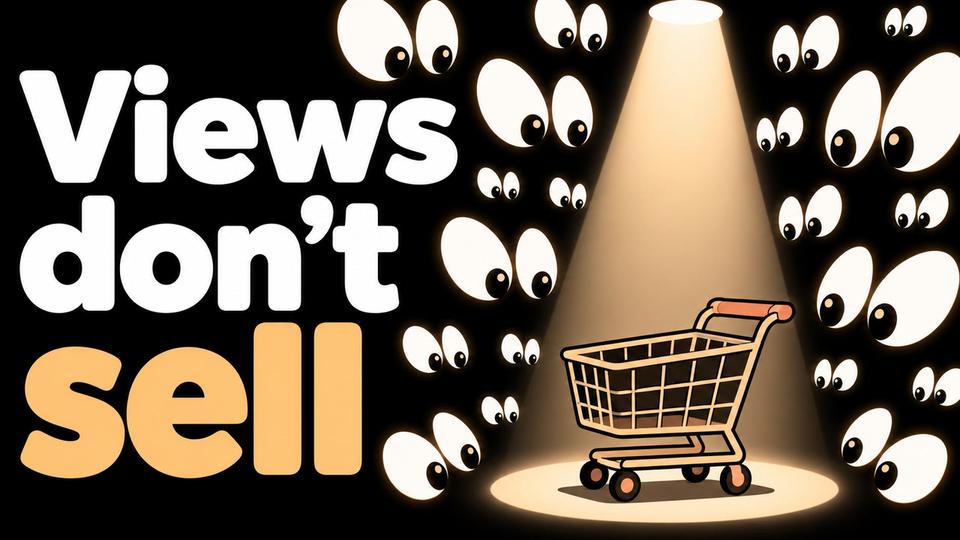
Attention has no value. Traffic itself has no value. We've seen it time and time again. People get thousands of views from Hacker News or Reddit, and it doesn't turn into a single sale. Sometimes not even sign-ups.
Why? Because their top of the funnel is in the stratosphere.
They write about the news, about what's trending, about what's controversial. Technical founders often humblebrag about their software architecture, or about solving hard technical challenges. Those usually have nothing to do with their ICP, by the way. So there are no sales.
We have to realize that our job as content marketers is not only to generate attention. Everyone seems to think marketing is all about generating attention.
The job is not only to generate attention. It's to turn attention into awareness, awareness into interest, interest into consideration, and so on, until it ultimately becomes a sale or a lead.
Your Competitors Convert at the Bottom
Most marketers realize this. But 99% of the industry still works on their funnel from the top down. They start at attention, maybe generate some awareness, but they lack the bottom-of-the-funnel content that would convert that traffic.
The lead goes on to research the topic with AI or on Google, which is mostly just AI anyway. And they end up buying from your competitors.
So you're working like a hero at the top of the funnel, and your competitors are converting at the bottom. Because your team won't work on the boring but necessary bottom-of-the-funnel content.
A solid content system needs a solid bottom. Just like building a house, you start with a strong foundation, and then you keep adding layers on top.
Virality isn't even the chimney on that house. At best, it's the holiday decoration. Stop shopping for decorations when you have no house.
5 Kinds of Content That Actually Sell
Instead of chasing traffic spikes, create as much content as you can on these topics:
- Who are you, and what do you stand for?
- What are you selling, and how does it work?
- Who bought from you, and why do they love you?
- What happens after a customer buys from you? What can they expect?
- How do you compare to your competitors? What's your unique selling proposition?
This is the kind of bottom-of-the-funnel content that actually moves the needle.
Two things to keep in mind:
- You can never have enough of this content. Spend at least 30% of your effort on it. Gimmicks, news and hype don't last. Your foundation can last for decades.
- Your website and your socials aren't enough to get the word out. In 2026, you need third-party support. You need people talking about you.
If you do this for a couple of months instead of chasing your viral breakthrough, you'll get way fewer visitors. But you'll get way more customers.
Once your bottom of the funnel is solid, keep slowly moving up the funnel, while keeping your customer at the center of your writing. That's how you do content marketing that helps your bottom line.
Inflate Your Pockets, Not Your Ego
Content marketing done right should inflate your pockets before it inflates your ego.
At Literally.dev, we specialize in high-performing technical content, and we get your product recommended by AI. If you're a tech company, you can apply for a free AEO analysis.